Digital nomad taxes have become a major challenge for employers and employees as remote work enables professionals to live and work across multiple countries. What began as a flexible lifestyle choice for freelancers has now expanded into mainstream employment, with companies allowing staff to work from anywhere. As this trend accelerates, digital nomad taxes are exposing gaps in traditional tax systems that were designed for fixed workplaces and single-country employment.
For organizations, the rise of digital nomads introduces legal, financial, and operational complexity. Tax authorities worldwide are scrutinizing how cross border work affects income tax, social security, and corporate obligations. As a result, companies are being forced to rethink remote work policies to avoid unintended tax exposure while ensuring ongoing compliance with local regulations.
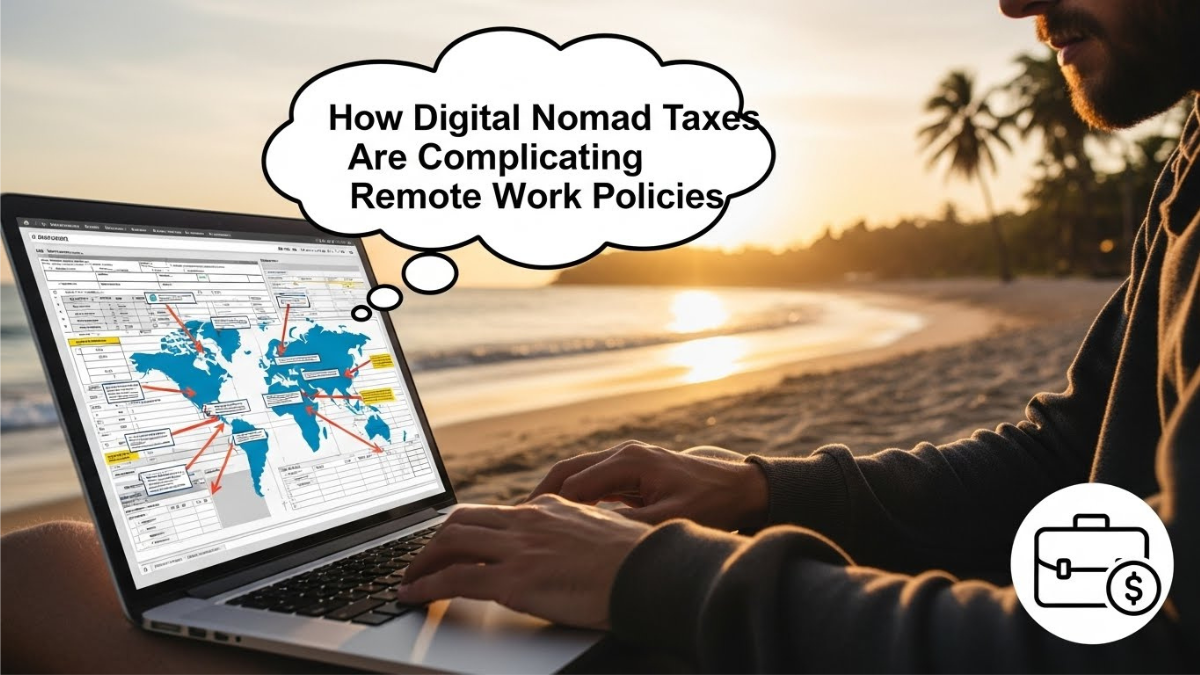
Cross border work and shifting tax obligations
The core challenge with digital nomad taxes lies in the nature of cross border work. When an employee works remotely from another country, even temporarily, it can trigger tax obligations in that jurisdiction. These obligations may include income tax, social contributions, or even corporate tax liabilities if the employee’s activities are deemed significant enough.
This creates uncertainty for both workers and employers. Employees may unknowingly become tax residents in multiple countries, while companies risk establishing a taxable presence without realizing it. Digital nomad taxes complicate remote work arrangements because tax residency rules vary widely, and cross border work often falls into gray areas not clearly addressed by existing treaties.
Compliance risks for employers and remote workers
Ensuring compliance is one of the most pressing concerns associated with digital nomad taxes. Employers must track where employees are working, for how long, and under what legal status. Failure to do so can result in penalties, audits, and reputational damage. As governments increase enforcement, ignorance is no longer a viable defense.
For employees, compliance challenges include understanding local tax filing requirements, social security contributions, and visa conditions. Many digital nomads assume short stays exempt them from obligations, which is not always the case. Without clear guidance, digital nomad taxes create financial risk and administrative burden for individuals engaged in cross border work.
Payroll complexity in a borderless workforce
Another significant issue is how payroll systems handle globally distributed employees. Traditional payroll processes are designed for single-country operations, with standardized tax withholding and reporting. Digital nomad taxes disrupt this model by requiring adjustments based on the employee’s physical work location rather than their home office or employer headquarters.
Managing payroll for digital nomads may involve split tax withholding, multiple reporting obligations, and coordination with local payroll providers. For organizations with large remote teams, this complexity increases operational costs and administrative workload. Without scalable solutions, payroll management becomes a bottleneck in supporting flexible work arrangements while maintaining compliance.
Key challenges created by digital nomad taxes include:
- Unclear tax residency rules
- Increased compliance monitoring requirements
- Complex payroll adjustments
- Risk of double taxation
- Administrative burden from cross border work
The table below outlines how digital nomad taxes differ from traditional employment taxation:
| Aspect | Traditional Employment | Digital Nomad Taxes |
|---|---|---|
| Work location | Fixed | Variable across borders |
| Tax residency | Clear | Often ambiguous |
| Payroll handling | Standardized | Multi-jurisdictional |
| Compliance risk | Predictable | Elevated |
| Cross border work impact | Limited | Central concern |
Policy responses and employer strategies
To manage digital nomad taxes, many companies are revising remote work policies with clearer geographic limits. Some restrict work to specific countries where tax treaties and payroll systems are already established. Others require pre-approval for international remote work to assess compliance risks before employees relocate.
Governments are also responding by introducing digital nomad visas and clarifying tax treatment for remote workers. While these initiatives help, they do not fully eliminate complexity. Employers must still evaluate how cross border work affects corporate tax exposure and payroll obligations. Strategic planning and expert guidance are becoming essential components of remote work management.
Long-term implications for remote work models
Over the long term, digital nomad taxes may reshape how organizations approach global talent. Fully location-independent work may give way to structured flexibility, where employees choose from approved locations with clear tax frameworks. This approach balances employee autonomy with manageable compliance and payroll processes.
For workers, understanding digital nomad taxes will become a core part of remote career planning. As tax authorities modernize enforcement, informal arrangements will carry greater risk. Clear policies, education, and transparent communication will be essential to sustain cross border work without undermining trust or flexibility.
Conclusion
In conclusion, digital nomad taxes are complicating remote work policies by introducing uncertainty around cross border work, compliance, and payroll management. As remote work becomes a permanent feature of the global workforce, organizations and employees must adapt to evolving tax realities. By proactively addressing digital nomad taxes through clear policies and informed decision-making, businesses can support flexibility while minimizing legal and financial risk.
FAQs
What are digital nomad taxes?
Digital nomad taxes refer to tax obligations that arise when individuals work remotely from countries other than their employer’s base.
Why does cross border work affect taxation?
Cross border work can trigger tax residency, income tax, or social security obligations in multiple countries.
How do digital nomad taxes impact payroll?
They require payroll adjustments to reflect different tax rules, reporting standards, and withholding requirements.
Who is responsible for compliance with digital nomad taxes?
Both employers and employees share responsibility for compliance, depending on local regulations.
Are digital nomad taxes likely to become simpler?
While some governments are clarifying rules, digital nomad taxes are expected to remain complex as remote work expands.
Click here to know more.